Jocker & Track-Jet: two outstanding solutions for tunnel maintenance

Tunnel maintenance requires machines capable of working on the crown in a controlled manner, reducing manual operations and adapting to the tunnel geometry. To meet these needs, we developed Jocker and Track-Jet, two tunnel maintenance machines dedicated respectively to mechanical milling and hydrodemolition.
The two solutions are based on different technologies, but share the same design philosophy: automating the most complex operations, keeping the operator at a distance from the work area, and making crown treatment more continuous. They are therefore not two competing machines, but two specific responses to different tunnel maintenance needs.
In summary
- Jocker performs concrete scarification and surface demolition using a milling cutter and works along the entire crown arch without requiring the machine to be repositioned.
- Track-Jet, on the other hand, uses high-pressure water to carry out hydrodemolition work and is a remotely controlled electric tracked machine.
- Jocker operates with a working radius ranging from 4.2 to 6.6 metres and reaches a milling depth of up to 150 mm.
- Track-Jet reaches a working radius ranging from 4 to 8 metres and has a working width of 2 metres.
- In both cases, automation and remote control reduce the operator’s presence in the area directly affected by the work.
Why specific machines are needed for tunnel maintenance
Working on a tunnel lining means operating on a curved surface extending above and to the sides of the machine, often in spaces where precision of movement and organisation of the operating phases are particularly important.
These constraints are accompanied by another requirement: limiting the time needed for the work. In road and motorway tunnels, maintenance activities can entail traffic restrictions or temporary closures. Making the process more rational and continuous therefore also means improving the overall organisation of the worksite.
Our range of tunnelling machines was created to address this type of challenge. Jocker and Track-Jet were developed specifically to work on tunnel crowns, but they use two different removal processes.
Jocker works through mechanical milling. Track-Jet, on the other hand, uses hydrodemolition with high-pressure water.
The selection criterion therefore starts with the process required by the project, not with an absolute comparison between the performance of the two machines.
Jocker by Laurini: how we automate crown milling
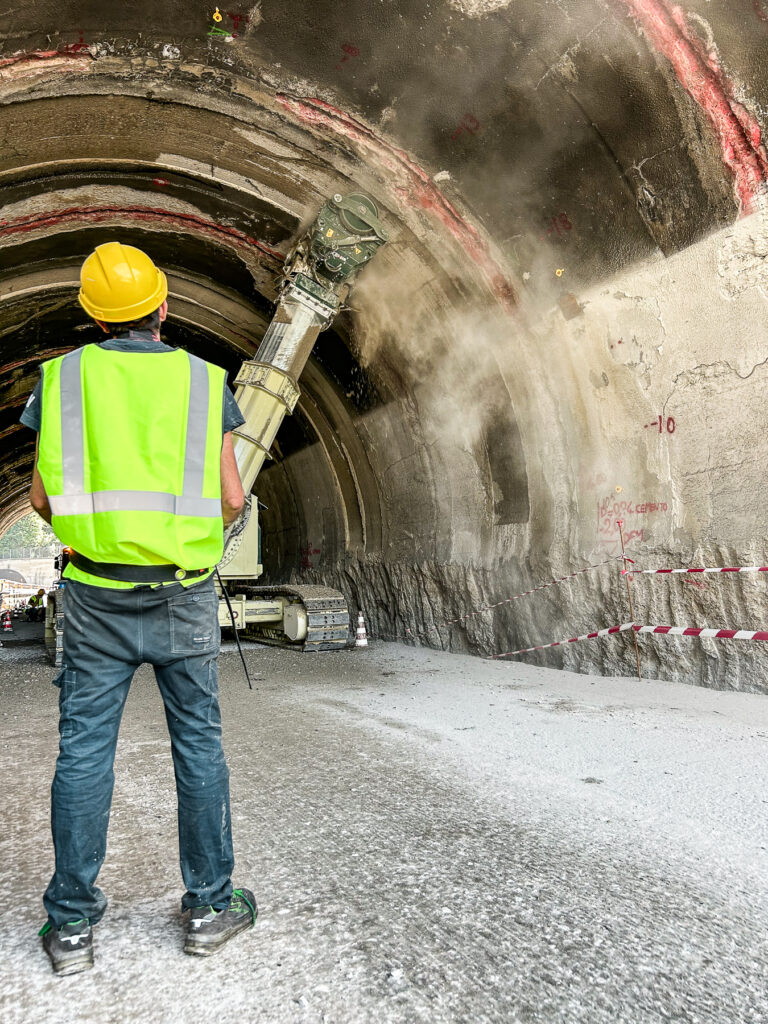
Jocker is our tunnel milling machine developed for scarifying and carrying out surface demolition on tunnel crowns.
The machine is positioned along the tunnel centreline. A telescopic boom carries the milling head to the surface to be treated and follows the crown geometry along the entire arch.
This principle overcomes one of the operational limitations of milling performed with a head installed on an excavator boom. In that configuration, the boom’s range of movement allows only a portion of the crown to be treated, making it necessary to reposition the vehicle to complete the work.
Jocker was designed to avoid this sequence. The boom follows the entire tunnel arch and allows the milling head to continue the pass without moving the machine from one side of the carriageway to the other.
The movement is managed automatically by following the crown geometry. The operator starts the advance, supervises the work, and gives the return command at the end of the pass.
Automation therefore acts directly on one of the most complex operations: controlling the cutter’s path over the tunnel’s curved surface.
How the Jocker tunnel milling machine is configured
Jocker is equipped with a 340 kW Caterpillar C13 engine, equivalent to 440 HP, paired with a Simex MP 1000 HD milling cutter.
The cutter drum is 1,000 mm long and 733 mm in diameter. The milling depth reaches 150 mm and is hydraulically adjustable by remote control.
The machine’s working radius ranges from 4.2 to 6.6 metres, a configuration designed to allow the boom to reach the surface to be treated along the crown.
The hydraulic system operates at a maximum pressure of 350 bar and an oil flow rate of 400 l/min. The total machine weight with a full fuel tank is 32,830 kg.
Under the best operating conditions, Jocker achieves productivity of up to 8 m³/h. Actual productivity naturally depends on the characteristics of the material, the required depth, and the specific working conditions.
Another design feature is the hydraulically extendable undercarriage. During travel, it keeps the machine’s overall width compact; during operation, it creates a wider base, which is necessary to ensure stability while milling.
In this way, transport and operation, which require different geometries, are managed by the same machine without sacrificing the stability needed when the boom operates on the crown.


Track-Jet: remotely controlled tunnel hydrodemolition
With Track-Jet, we applied the same specialisation logic to a completely different process: tunnel hydrodemolition.
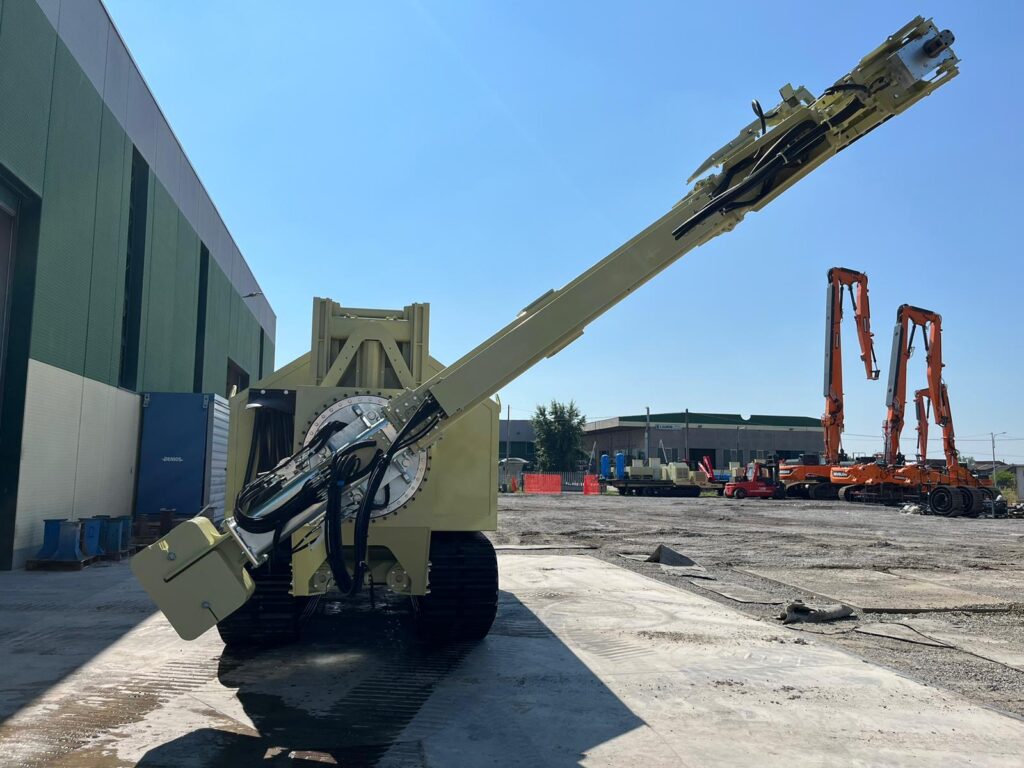
Track-Jet is a remotely controlled electric tracked machine equipped with a telescopic boom mounted on a slewing ring. At the end of the system is an oscillating nozzle holder that performs the work using high-pressure water.
The machine reaches a working radius ranging from 4 to 8 metres and has a working width of 2 metres.
The main electric motor delivers 37 kW, while the hydrodemolition process uses water at a pressure of up to 1,500 bar.
The movement of the boom and lance is robotised. A hydraulic control unit programmable through dedicated software manages the movement of the working tool over the surface.
Track-Jet is controlled by a single operator on the ground via a transmitter unit.
This aspect is particularly important in the relationship between automation and safety: the operator controls the machine remotely and does not need to be in the area immediately affected by the high-pressure water jet.
The choice of a fully electric drive also responds to the specific conditions of the working environment. In a tunnel, where ventilation and air quality are factors to consider in worksite organisation, eliminating the combustion engine from the machine means avoiding its exhaust emissions during operation.

Jocker and Track-Jet: two technologies for two different processes
Comparing Jocker and Track-Jet solely on the basis of installed power would be meaningless. One uses a mechanical milling process; the other uses a hydrodemolition process.
The main difference is therefore how the material is removed.
| Feature | Jocker | Track-Jet |
| Process | Mechanical milling | Hydrodemolition |
| Working tool | Simex MP 1000 HD milling cutter | Oscillating nozzle holder |
| Working radius | 4.2-6.6 m | 4-8 m |
| Power unit | Caterpillar C13, 340 kW / 440 HP | Electric, 37 kW |
| Control | Radio remote control and automatic advance | Remote control and robotised movements |
| Working range | 1,000 mm drum | 2 m working width |
| Process parameter | Depth up to 150 mm | Water pressure up to 1,500 bar |
| Application | Scarification and surface demolition | Surface hydrodemolition |
This distinction also explains why we developed two machines instead of trying to adapt a single platform to different processes.
Milling requires stability, mechanical power, depth control, and the ability to guide the head along the crown. Hydrodemolition, on the other hand, requires high-pressure jet management, lance control, and programmable movement over the surface.
The general challenge is the same. The technology used to solve it changes.
Automation: fewer repositioning operations and greater control over the process
One of the elements Jocker and Track-Jet have in common is the role of automation.
For Jocker, we focused above all on the continuity of milling along the arch. The system allows the boom to follow the crown without requiring the machine repositioning needed with a traditional excavator-based configuration.
This means eliminating a sequence of stopping, moving, and repositioning during the same operation.
On Track-Jet, automation instead concerns management of the boom and lance. Robotised movement makes it possible to control the nozzle path while the operator manages the system remotely.
In both cases, the principle is the same: the operator is not required to reproduce complex movements manually along the crown geometry for the entire duration of the work.
Automation therefore does not replace operator control. It changes how that control is exercised.
Safety: moving the operator away from the work area
In the design of both machines, safety and automation are closely linked.
Milling produces direct mechanical interaction between the tool and the lining. Hydrodemolition, on the other hand, uses water at extremely high pressures. They are different processes, but both define a work area from which personnel not required for the operation should be kept separate.
Remote control allows the operator to supervise the process from a position away from the working tool.
On Jocker, this is achieved through radio remote control and automated pass management. On Track-Jet, the principle is further developed through remote control and robotised movements of the boom and lance.
Safety therefore does not derive from a single feature, but from the architecture we used to design the relationship between machine, tool, and operator.
Productivity: why it does not mean only cubic metres per hour
For Jocker, milling capacity can also be expressed through a quantitative figure: up to 8 m³/h under the best conditions.
However, in tunnel maintenance, productivity does not correspond only to the amount of material removed in one hour.
It is also necessary to consider how much time is spent positioning and repositioning the machine, controlling the process, and completing a pass over the intended surface.
This is where the specialisation of Jocker and Track-Jet becomes relevant.
Jocker can travel along the crown arch without being repositioned laterally. Track-Jet automates nozzle movement over the surface through its robotised system.
Two different processes, therefore, but the same design objective: eliminating steps that do not directly perform the work and making the operating cycle more continuous.
Which machine should be chosen for tunnel maintenance?
The choice between Jocker and Track-Jet must start with the required process.
When the work requires mechanical milling and scarification, Jocker provides a milling head designed to operate on the crown at depths of up to 150 mm.
When the project instead requires hydrodemolition, Track-Jet performs the treatment using high-pressure water with robotised nozzle movement.
The tunnel geometry must also be considered. Jocker operates with a working radius of 4.2-6.6 metres; Track-Jet covers a range of 4-8 metres.
The aim is therefore not to identify one machine as universally higher-performing. The material to be removed, the required process, the tunnel geometry, and the worksite organisation must first be defined.
Only then do the specific characteristics of the two machines become selection criteria.
Frequently asked questions about Jocker and Track-Jet
Do Jocker and Track-Jet perform the same process?
No. Jocker is a tunnel milling machine and removes material through a mechanical process. Track-Jet is designed for hydrodemolition and uses high-pressure water. Both work on tunnel crowns, but use different technologies.
Does Jocker need to be repositioned to mill the entire crown?
No. Jocker is positioned along the tunnel centreline, and the boom movement system allows the cutter to follow the entire crown arch without having to reposition the machine laterally during the pass.
What is Jocker’s maximum milling depth?
Jocker reaches a milling depth of up to 150 mm, hydraulically adjustable by remote control.
Is Track-Jet remotely controlled?
Yes. Track-Jet is managed by a single operator on the ground via a transmitter unit. The movements of the boom and lance are robotised and controlled through a programmable control unit.
What is the working radius of the two machines?
Jocker operates with a working radius ranging from 4.2 to 6.6 metres. Track-Jet, on the other hand, reaches a working radius ranging from 4 to 8 metres.
Which solution offers greater productivity?
It is not correct to compare the productivity of the two machines directly because they perform different processes. Jocker achieves a milling capacity of up to 8 m³/h under the best conditions. For Track-Jet, the assessment must refer to the specific parameters of the hydrodemolition process and the conditions of the work.
Jocker and Track-Jet: designing the machine around the process
There is no single removal technology for tunnel maintenance and, consequently, there cannot be one machine equally suitable for every operation.
We developed Jocker and Track-Jet based on this principle.
With Jocker, we focused the design on mechanical crown milling, pass continuity, and the ability to follow the tunnel geometry automatically. With Track-Jet, we applied the same logic to hydrodemolition, using electric power, remote control, and robotised nozzle movement.
The common point is therefore not the process, but the design method: starting from the actual operation and building the machine around the conditions in which it must work.
To assess which technology and configuration are best suited to a specific maintenance project, our technical team is available to analyse the tunnel characteristics and project requirements.